Topic
Circular saws
Circular saws rip and crosscut sheet goods, decking and studwork faster than a hand saw. Plunge track saws add a guide rail for straight, splinter-free edges.
- Common blades
- 165 · 184 · 190 mm
- Depth at 90 degrees
- About 55 to 66 mm
Blade size sets the depth of cut. A 165 mm saw cuts about 55 mm deep at 90 degrees, a 190 mm saw around 65 mm, which matters for 47 mm and 63 mm timber.
A plunge track saw drops the blade into the work along an aluminium rail. It gives factory-straight edges on worktops, doors and 2440 x 1220 mm sheets without a table saw.
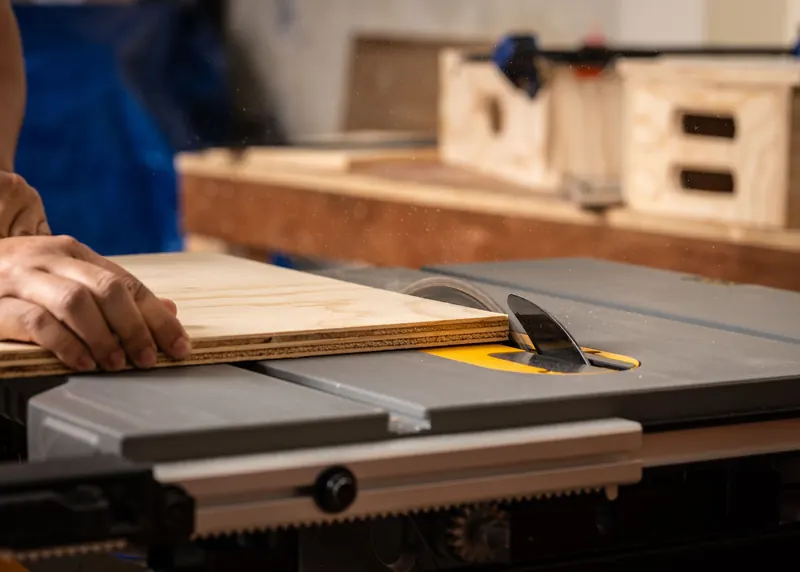
Cordless site table saws suit repeated rip cuts on site. Whatever you choose, a blade with more teeth leaves a cleaner edge, and fewer teeth cut faster.
Guides on this topic
- What size circular saw do you need?Circular saw blade sizes from 165 mm to 235 mm and beyond, with typical cutting depths at 90 and 45 degrees and which size suits sheet goods, decking and joists.Guide
- How to use a circular sawBlade depth, supporting the offcut, using the line guide and starting the cut, with standard kickback precautions for corded and cordless saws.How-to
- How to cut straight with a circular saw and guide railClamped straight edges, rail adaptors and offset measuring for clean, straight cuts in sheet material with a standard circular saw.How-to
- Corded vs cordless circular sawCorded and cordless circular saws compared on power, cutting depth, runtime for sheet goods and decking, and when a 240 V or 110 V saw still makes sense.Comparison
- Circular saw vs track saw for sheet materialRail guided plunge cuts against a standard circular saw with a clamped straight edge, compared by finish, accuracy, setup and cost.Comparison
- Circular saw vs reciprocating sawCircular saws make straight, accurate cuts in sheet and timber; reciprocating saws make fast rough cuts in place. See which suits your project and why.Comparison
- Circular saw vs jigsaw: straight cuts or curves?Straight, fast cuts against curves and cut outs: how circular saws and jigsaws differ and which to buy first for kitchen and decking jobs.Comparison
- Circular saw kickback: why it happens and how to stop itWhy a circular saw kicks back, from pinched kerfs and twisted cuts to dull blades, and how to set up, support and cut so the saw stays under control.Fix
- Circular saw binding or burning the wood: fixesBlunt or wrong blades, pinched kerfs, poor support and a misaligned base plate: why circular saws bind and burn wood, and how to fix each cause.Fix
Buying guides on this topic
- Best cordless circular sawsCordless circular saws compared by blade size, depth of cut, guide rail compatibility and box contents, from bare units to kits with batteries.Buying guide
- Best plunge and track sawsPlunge and track saws compared by power source, maximum depth, guide rail fit and whether a rail, batteries or charger come in the box.Buying guide
- Best site and bench table sawsPortable site and bench table saws compared by blade size, power, listed depth of cut, rip capacity and whether a stand comes in the box.Buying guide