How-to
How to use a mitre saw
Published
Note: This page contains affiliate links. If you buy through them we may earn a commission at no extra cost to you. Learn more
In short
Set the saw on a stable bench, check the guard moves freely, set the mitre and bevel angles and lock them, clamp the work against the fence, start the saw and let it reach full speed, lower the blade steadily through the cut, then let the blade stop before raising the head. Keep hands well clear and wear eye and ear protection.
Products for this job
Compare all 7 productsMetabo KGS 254 M: 254 mm sliding saw, 92 mm deep
Check price on AmazonAffiliate linkDeWalt DWS774: 216 mm slide saw, 250 mm wide, XPS
Check price on AmazonAffiliate linkEvolution R255SMS+: 255 mm multi-material sliding saw
Check price on AmazonAffiliate link
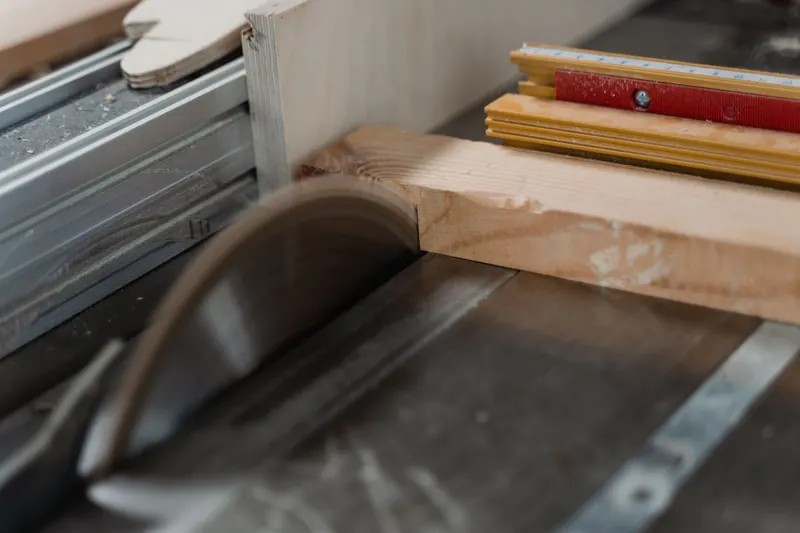
A mitre saw makes accurate, repeatable crosscuts and angles quickly, which is why it is the centre of most trim, flooring and decking jobs. It is also one of the more dangerous tools in a home workshop if used carelessly. This guide covers setting up, making straight, mitre, bevel and compound cuts, using the slide and depth stop, and the safety habits that matter.
Set up and checks
Bolt or clamp the saw to a solid bench or stand at a comfortable height, with support for long boards on both sides. Unplug it or remove the battery before any adjustment. Check the blade is sharp and fitted the right way round, the lower guard moves freely and springs back, and the dust bag or extraction is connected.
Check the saw cuts square before important work. See mitre saw not cutting square.
- Saw secured to a stable surface.
- Lower guard moves freely and returns.
- Blade sharp, correct way round, flange tight.
- Mitre and bevel locks working.
- Eye and ear protection, and a dust mask for MDF.
Making a straight crosscut
Set the mitre to 0 and the bevel to 0. Mark the cut line and decide which side of the line the blade should cut, so the finished piece is the right length. Hold the board firmly against the fence and table, or clamp it, with your hand well outside the marked no hands zone, typically at least 150 mm from the blade.
Pull the trigger and let the blade reach full speed before it touches the wood. Lower the head steadily. Release the trigger at the bottom and let the blade stop completely before raising it.
- 1
Set mitre and bevel to 0 and lock.
- 2
Mark the line and position the board.
- 3
Clamp or hold firmly against the fence.
- 4
Start the saw and let it reach full speed.
- 5
Lower the blade steadily through the cut.
- 6
Release the trigger and wait for the blade to stop before raising.
Mitre, bevel and compound cuts
For a mitre, unlock the turntable, swing it to the angle and lock it; most saws have detents at common angles such as 15, 22.5, 30 and 45 degrees. For a bevel, unlock the bevel and tilt the head. For a compound cut, set both. Make a test cut on scrap first.
For frames and polygons, use our mitre angle calculator to find the setting.
Mitre
An angle across the face.
Bevel
A tilt through the thickness.
Compound
Both at once, as on coving.
Using the slide
On a sliding saw, wide boards are cut by pulling the head towards you, lowering it at the front edge of the board, then pushing it back through the wood. Pushing away from you keeps the blade from climbing onto the work. Lock the slide for narrow boards so it acts as a fixed chop saw.
Using the depth stop
The depth stop limits how far the head lowers. Set it to cut part way through for housing joints, notches or trenches, then make several passes. It is also useful for cutting thin slots in the same position on many pieces. Check your manual for how to set it.
Cutting accurately
Use a length stop or a block clamped to the support for repeated pieces. Let the blade do the work and do not force it. For clean edges on trim, use a fine tooth blade; see mitre saw blades explained. Shadow line or laser guides help line up cuts.
Habits that keep you safe
Never cross your arms over the blade path, reach behind the blade, or try to catch offcuts while the blade is moving. Do not cut pieces so short that your hand must be near the blade; cut them from a longer piece. Do not cut round or warped stock without proper support, as it can roll and grab.
If the guard sticks or the blade wobbles, stop and fix it before carrying on.
Note:Mitre saws can cause serious injury. Keep guards working, clamp the work, keep hands outside the no hands zone, let the blade stop before raising the head, and wear eye and ear protection. Follow the manual and HSE woodworking guidance.
Choosing a saw
If you are still choosing, read what size mitre saw you need and compare models in our mitre saw guide and sliding mitre saw guide.
Frequently asked questions
Which way should a mitre saw blade face? The teeth at the bottom of the blade point towards the back fence, and the arrow on the blade matches the arrow on the guard.
Can I cut metal with a mitre saw? Only with a saw and blade designed for it, such as Evolution's multi-material saws. Standard wood saws and blades are not for metal.
Why does the saw grab the wood? Often because the board is not held firmly, the blade is blunt, or you are pulling a sliding saw through the cut. Clamp, use a sharp blade and push away from you.
How do I cut skirting on a mitre saw? See how to cut skirting board corners for internal, external and out of square corners.
What you need
- Check price on AmazonAffiliate link
Metabo KGS 254 M: 254 mm sliding saw, 92 mm deep
- Check price on AmazonAffiliate link
Evolution R255SMS-DB+: double bevel, 300 x 80 mm
- Check price on AmazonAffiliate link
Metabo KGS 18 LTX BL 216: kit with 4 Ah pack and charger
From: Best cordless mitre saws