Guide
What is a combi drill?
Published
Note: This page contains affiliate links. If you buy through them we may earn a commission at no extra cost to you. Learn more
In short
A combi drill is a cordless drill with three modes: drill for wood and metal, driver with an adjustable clutch for screws, and hammer for brick and block. It is the most useful single power tool for most UK homes, because it handles shelves, curtain poles, flat-pack and plug holes in masonry.
Products for this job
Compare all 6 productsDeWalt DCD996P2: 95 Nm, three speeds, two 5 Ah packs
Check price on AmazonAffiliate linkBosch GSB 18V-45: light 45 Nm brushless kit, 2 x 2 Ah
Check price on AmazonAffiliate linkMilwaukee M18FPD2: 135 Nm Fuel drill with one 5 Ah pack
Check price on AmazonAffiliate link
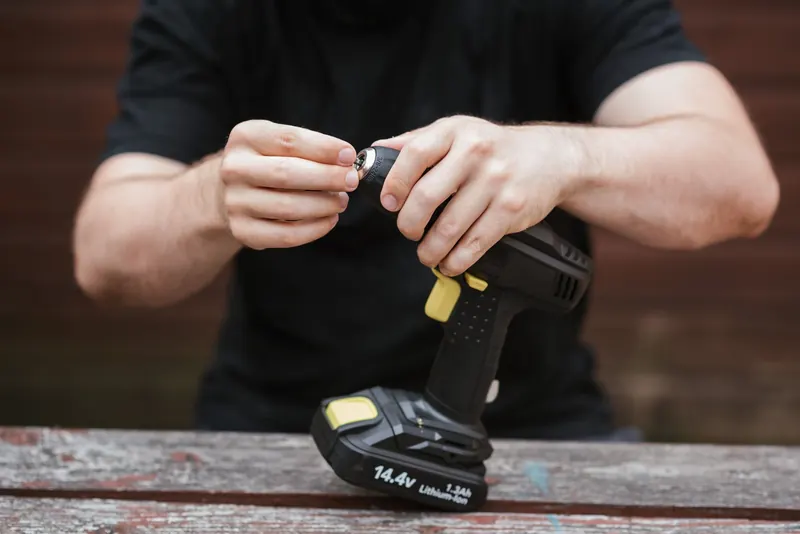
Combi is short for combination: one tool that combines a drill, a screwdriver and a light hammer drill. It is the drill most people mean when they say cordless drill in the UK, and it is usually the first tool on any battery platform. This article explains the three modes, the clutch ring, the gear switch and what to look for when you buy one.
The three modes
The collar behind the chuck selects the mode. In drill mode the chuck turns with full torque and no clutch, for drilling holes in wood, metal and plastic. In driver mode the numbered clutch ring sets a torque limit, so the clutch slips with a ratcheting sound once a screw reaches that resistance. In hammer mode the chuck turns and also pulses forward and back to chip into masonry.
Drill
Bit spins. Wood, metal, plastic.
Driver
Clutch 1 to 20 slips at a set torque.
Hammer
Spin plus forward pulses. Brick, block.
- Drill symbol: holes in wood, metal, plastic and tile.
- Numbers 1 to about 20: driving screws with a torque limit.
- Hammer symbol: holes in brick, block and mortar.
The clutch ring
The clutch is what makes a drill a good screwdriver. Low numbers slip early, for small screws into soft wood and hinges. Higher numbers allow more torque for longer screws. Start low and step up until the screw sits flush. The clutch only works in driver mode; in drill and hammer modes it is bypassed.
Full details and starting settings are in drill clutch and speed settings explained.
The gear switch
On top of most combi drills is a slider marked 1 and 2 (some have three speeds). Gear 1 is slow with high torque, for driving screws, large hole saws and augers. Gear 2 is fast with less torque, for small drill bits in wood, metal and masonry. Change gear only when the drill is stopped.
The trigger is variable, so you can start slowly in either gear to keep the bit on its mark.
How the hammer works
Inside the gearbox, two ridged discs ride over each other as the chuck turns, making it pulse forward and back thousands of times a minute. The blows are small, so you push the drill into the wall to help them work. It is effective in brick, block and mortar, and slower in hard concrete.
For lots of concrete or holes above about 10 mm, an SDS drill is better. See SDS drill vs combi drill and what is an SDS drill.
What to look for when buying
Torque in newton metres shows how hard a drill can turn: 40 to 60 Nm suits most home jobs, 90 Nm and above suits large bits and trade work. Weight and head length matter if you work overhead. Brushless motors give more runtime per charge. Most importantly, check what is in the box: a kit has batteries and a charger, while a bare unit or body only has neither.
Our combi drill kit guide and home use guide compare current kits by these figures.
| Listed torque | Typical use |
|---|---|
| 30 to 45 Nm | Flat-pack, small fixings, light DIY |
| 45 to 70 Nm | General home and garden projects |
| 70 to 100 Nm | Large hole saws, long screws, regular use |
| Over 100 Nm | Heavy boring, trade use |
Batteries and platforms
A cordless combi drill is also the start of a battery platform. The pack you buy with it will run every other tool you add from that brand, so think about saws, sanders and garden tools you may want later. 18 V packs from 2 to 5 Ah are common: 2 Ah keeps the drill light, 4 to 5 Ah gives longer runtime for bigger jobs.
Read how to choose a cordless battery platform before your first purchase, and volts and amp hours explained for what the numbers mean.
Combi drill or something else?
If you will never drill masonry, a drill driver is a little smaller. If you drive lots of long screws, add an impact driver. If you drill concrete often, add an SDS drill. For most homes, though, a combi drill is the right first tool. Compare it with a driver in combi drill vs impact driver.
Note:Wear eye protection, check walls for cables and pipes before drilling, and never wear loose gloves near a turning chuck. Follow the drill's manual.
Frequently asked questions
Is a combi drill the same as a hammer drill? In the UK, a combi drill is a cordless drill with a hammer mode, so it is a type of hammer drill. Corded hammer drills and SDS drills are different tools.
Can a combi drill go through concrete? Small holes, slowly, with a sharp masonry bit. For regular concrete work an SDS drill is far quicker.
What size chuck do I need? 13 mm is standard and takes most bits. Compact 12 V drills often have 10 mm chucks, which limit larger bits.
What voltage should I buy? 18 V suits most people. 12 V is lighter for small jobs. Higher voltage platforms suit heavy tools rather than drills.
What you need
- Check price on AmazonAffiliate link
DeWalt DCD996P2: 95 Nm, three speeds, two 5 Ah packs
- Check price on AmazonAffiliate link
Bosch GSB 18V-45: 920 g brushless kit for home jobs
- Check price on AmazonAffiliate link
DeWalt DCD805NT: compact 18 V XR, 90 Nm, bare unit