Guide
How to choose a cordless battery platform
Published
Note: This page contains affiliate links. If you buy through them we may earn a commission at no extra cost to you. Learn more
In short
List the tools you expect to own in the next few years, then choose the brand whose battery runs most of them well. Consider battery and charger cost, garden tools on the same pack, weight and where you can buy. Your first kit sets the platform, because bare tools are cheap once you own batteries, while switching brands means buying packs again.
Products for this job
Compare all 5 productsBosch GSB 18V-110 C and GDR 18V-210 C, 2 x 5 Ah
Check price on AmazonAffiliate linkDeWalt DCK276P2: DCD996 and DCF887, 2 x 5 Ah
Check price on AmazonAffiliate linkHiKOKI KC18DEWAZ: 140 Nm drill plus 175 Nm impact
Check price on AmazonAffiliate link
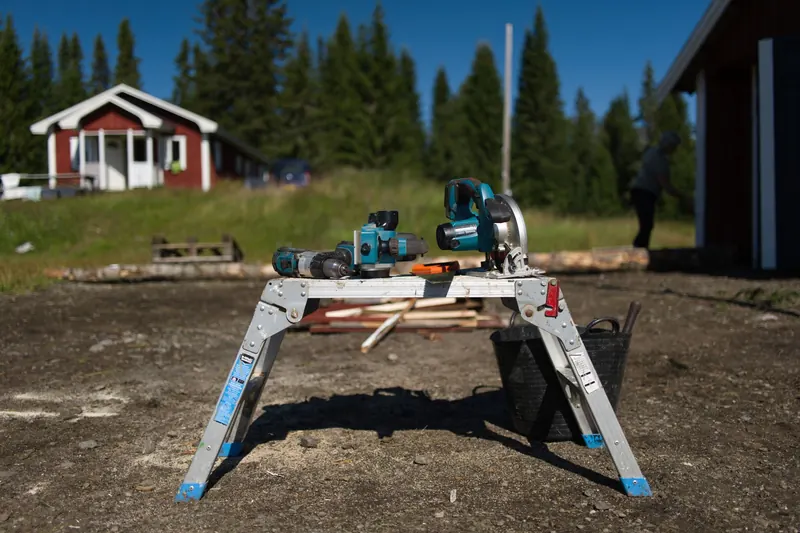
Buying your first cordless drill is really buying into a battery system. Every tool you add later will either use those batteries or force you to start again with a new set. That makes the first choice more important than it looks. This guide explains what to weigh up, how the main UK platforms differ and when corded tools still make sense.
Why the first purchase locks you in
Batteries and chargers are a large part of the cost of a cordless kit. Once you own a few packs, bare tools on the same platform are much cheaper than buying a new kit. Switching brands means buying batteries and chargers again, and keeping two sets of chargers. That is why many people stay with the brand of their first drill for decades.
Before buying, think beyond the drill. Do you want a circular saw, a mitre saw, a multi-tool, a hedge trimmer or a mower? Check that the brand makes good versions of them on the same battery.
The main UK platforms
The table summarises the main cordless systems sold in the UK. All have broad ranges; the notes show what each is known for.
10-cell packs: two strings of five in parallel, still 18 V, double the Ah. Wh = V x Ah.
| Brand | Main system | Notes |
|---|---|---|
| Makita | 18 V LXT | Very broad range including garden tools; twin 18 V tools; separate 40 V max XGT |
| DeWalt | 18 V XR | Strong site range; FlexVolt packs run 54 V tools and fit 18 V tools |
| Milwaukee | M18 and M12 | Trade focus; Fuel high output tools; strong compact M12 range |
| Bosch Professional | 18 V, AMPShare | Batteries shared with several partner brands under AMPShare |
| Ryobi | ONE+ 18 V | Large home and garden range, often good value kits |
| Einhell | Power X-Change 18 V | Wide home and garden range; twin pack tools for 36 V |
Garden tools on the same battery
If you also want a mower, strimmer, hedge trimmer or blower, check the garden range. Makita, Ryobi and Einhell are especially broad, and Ryobi bundles often pair a drill kit with a garden tool. Larger garden tools draw a lot of power, so you will want bigger packs or twin pack tools.
Our power tool kit guide includes bundles that pair drills with garden tools.
Trade or home use?
Trade users often choose Milwaukee, DeWalt, Makita or Bosch Professional for durability, service networks and what colleagues use on site, since shared batteries help. Home users can get excellent value from Ryobi and Einhell, which have huge home and garden ranges, or from the pro brands' compact lines.
Weight and size matter too. If most of your work is light, a 12 V platform or compact 18 V tools will be more comfortable.
Batteries, chargers and value
Compare packs in watt hours, not just volts or amp hours: 18 V x 5 Ah = 90 Wh. See volts and amp hours explained. A twin pack with a drill, impact driver, two batteries and a charger is usually the cheapest way in. After that, buy bare tools.
Check what the kit actually includes. Our twin pack guide states the batteries and charger for each.
Corded or cordless?
Cordless tools are now powerful enough for almost every home job, and the convenience is hard to beat. Corded tools still make sense for tools that run for long periods in one place, such as table saws, large mitre saws and sanders, and they cost less for the same capacity.
Many people run cordless drills, drivers and portable saws, and keep a corded mitre saw or table saw in the workshop. On UK sites, corded tools are usually 110 V and run from a transformer; for home use buy 230 to 240 V versions.
A simple decision process
Work through these steps before buying. It takes ten minutes and can save a lot of money later.
- 1
List the tools you will want over the next three to five years.
- 2
Check which brands make all of them on one battery.
- 3
Hold the drills you are considering with a battery fitted.
- 4
Compare kit contents, batteries and warranty terms.
- 5
Buy a twin pack or kit, then add bare tools.
Frequently asked questions
Can I mix battery brands with adaptors? Adaptors exist but may bypass protection circuits and void warranties. It is safer to stay on one platform.
Is AMPShare worth considering? If you like Bosch Professional and want tools from partner brands on the same pack, it widens the choice. Check which tools are included.
Should I buy 12 V or 18 V? 18 V for most people. 12 V suits light, compact work and installers who value low weight.
Are cheap unbranded tools a good idea? They can be fine for occasional use, but battery quality, safety features and spares vary. Buy from reputable sellers.
What you need
- Check price on AmazonAffiliate link
Bosch GSB 18V-110 C and GDR 18V-210 C, 2 x 5 Ah
- Check price on AmazonAffiliate link
Bosch GSB 18V-45 plus GBH 18V-22 kit, 2 x 4 Ah
- Check price on AmazonAffiliate link
DeWalt DCD996P2: 95 Nm, three speeds, two 5 Ah packs