How-to
How to drill into brick, block and concrete
Published
Note: This page contains affiliate links. If you buy through them we may earn a commission at no extra cost to you. Learn more
In short
Check the wall for cables and pipes, fit a sharp masonry bit matching the wall plug, set your combi drill to hammer mode and a high gear, and drill steadily with firm pressure, clearing dust as you go. Brick and block drill easily; concrete is slower and often needs an SDS drill. Never use an impact driver for masonry.
Products for this job
Compare all 6 productsDeWalt DCD996P2: 95 Nm, three speeds, two 5 Ah packs
Check price on AmazonAffiliate linkBosch GSB 18V-45: light 45 Nm brushless kit, 2 x 2 Ah
Check price on AmazonAffiliate linkMilwaukee M18FPD2: 135 Nm Fuel drill with one 5 Ah pack
Check price on AmazonAffiliate link
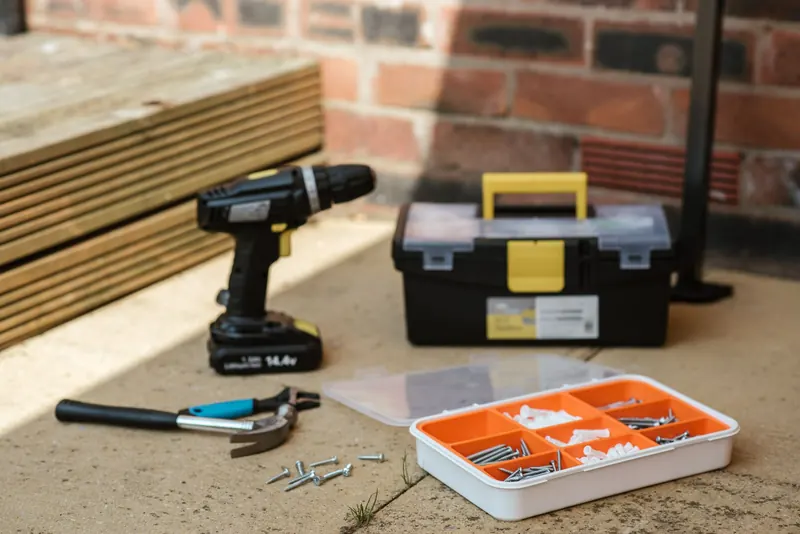
Most UK homes have masonry walls: brick, concrete block or a mix, often under a layer of plaster. Fixing shelves, brackets and curtain poles means drilling them. This guide shows how to do it with a cordless combi drill, how to tell which material you are in, and when to reach for an SDS drill instead.
Check what is behind the wall
Before drilling, use a cable and pipe detector. Cables usually run vertically or horizontally from sockets, switches and lights, so avoid those zones. Pipes may run in any direction under floors and to radiators. If the detector is unsure, move the fixing.
Note what the wall is made of. Tap it: solid masonry sounds dull, a stud wall sounds hollow, and plasterboard on dabs sounds partly hollow. Stud walls and dot and dab need cavity fixings, not masonry plugs.
- Red or yellow dust: brick.
- Grey dust, easy drilling: aerated block.
- Grey dust, slow and hard: dense block or concrete.
- White dust then nothing: plaster over a cavity.
Choose the right bit and plug
Use a masonry bit, which has a tungsten carbide tip. Match the bit diameter to the plug, printed on the plug packet. Common UK plugs are colour coded, but sizes vary by maker, so always check the pack. The full table is in which drill bit for wall plugs.
Mark the drilling depth with tape on the bit: plug length plus about 5 mm.
Drilling with a combi drill
Set the collar to hammer and the gear to 2. If the wall is tiled, drill through the tile in drill mode with a tile bit first, then switch. Hold the drill square to the wall, start slowly to stop the bit wandering, then increase speed and push firmly.
Drill
Bit spins. Wood, metal, plastic.
Driver
Clutch 1 to 20 slips at a set torque.
Hammer
Spin plus forward pulses. Brick, block.
- 1
Mark the position and check for cables and pipes.
- 2
Fit the masonry bit and set the depth tape.
- 3
Select hammer mode and gear 2.
- 4
Start slowly, then increase speed with firm pressure.
- 5
Pull the bit out every few seconds to clear dust.
- 6
Stop at the tape, vacuum the hole and fit the plug.
Concrete and hard materials
Concrete lintels, engineering brick and dense block are much harder. A combi drill will get through small holes slowly, but the bit gets hot and wears. Let it cool, keep it sharp and do not lean on the drill so hard that it stalls.
If you hit something that will not budge, it may be a stone in the concrete or reinforcing steel. Stop. Drilling into steel with a masonry bit will not work, and it could be a structural element. Move the fixing slightly.
For regular concrete work or holes above about 10 mm, use an SDS drill. See SDS drill vs combi drill and our SDS drill guide.
Why not an impact driver?
An impact driver's hammer blows are rotational, around the bit, not forward into the wall. It does not chip masonry the way a combi or SDS drill does, and hex masonry bits for drivers are slow. Use it for driving the screws once the plugs are in.
Avoiding common problems
Holes too big for the plug usually come from the bit wobbling or wandering at the start, or from soft brick crumbling. Start slowly, keep the drill square and use the right size bit. If a hole is oversized, use a larger plug or a resin fixing.
Plaster cracking around the hole can be reduced by drilling the plaster without hammer and switching on hammer only in the brick behind.
Choosing a drill for masonry
Any decent combi drill handles shelves and curtain poles. Look for a hammer mode, a 13 mm chuck and reasonable torque. If you will drill concrete often, add a cordless SDS drill on the same battery. Our combi drill kit guide shows what each kit includes.
Note:Wear eye protection and a dust mask: brick and concrete dust contains silica, which HSE warns is harmful to breathe. Use a vacuum to clear holes. If you are unsure about cables, pipes or structural elements, ask an electrician or builder before drilling.
Frequently asked questions
Can I drill into mortar instead of brick? Mortar is softer and easier to drill, but plugs may hold less well in crumbly lime mortar. Brick usually gives a firmer fixing.
Why is my masonry bit not going in? It may be blunt, the drill may not be in hammer mode, or you may have hit concrete or steel. Check the mode, try a new bit or move the hole.
Do I need a special bit for concrete? A good quality masonry bit works in a combi drill. For an SDS drill use SDS plus bits.
How deep should I drill for a plug? Plug length plus about 5 mm, so the plug sits flush and dust has somewhere to go.
What you need
- Check price on AmazonAffiliate link
DeWalt DCD996P2: 95 Nm, three speeds, two 5 Ah packs
- Check price on AmazonAffiliate link
DeWalt DCH263N: 3 J brushless SDS plus, 28 mm, bare
From: Best cordless SDS drills
- Check price on AmazonAffiliate link
Bosch GSB 18V-45: 920 g brushless kit for home jobs