Guide
Which drill bit for which wall plug?
Published
Note: This page contains affiliate links. If you buy through them we may earn a commission at no extra cost to you. Learn more
In short
Use a masonry bit the same diameter as the plug, which is printed on the packet. As a typical guide for UK colour coded plugs: yellow 5 mm, red 6 mm, brown 7 mm and blue 10 mm, though makers vary. Match the screw to the plug too: small gauge 4 to 8 screws for yellow, up to gauge 14 and above for brown and blue.
Products for this job
Compare all 7 productsBosch GSB 18V-45: 920 g brushless kit for home jobs
Check price on AmazonAffiliate linkRyobi RPD18BL2: brushless ONE+ drill with 5 Ah and bit kit
Check price on AmazonAffiliate linkBosch GSB 12V-35: compact 12 V combi with two 3 Ah packs
Check price on AmazonAffiliate link
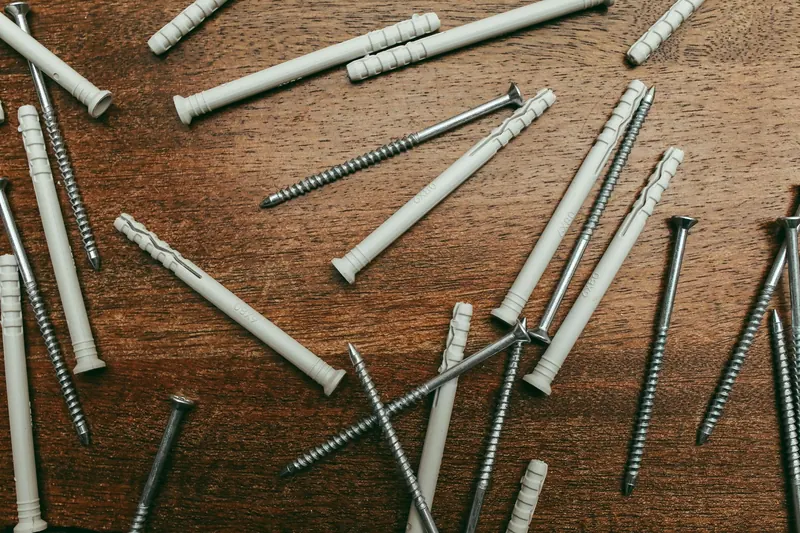
Wall plugs only hold properly when the hole is the right size and depth and the screw suits the plug. Too big a hole and the plug spins; too small and it will not go in or it splits. UK plugs are often colour coded, but sizes are not fully standard between makers. This guide gives typical sizes and the checks that matter.
Typical UK colour codes
The table shows typical sizes for the common colours. Always check the plug packet, because some brands use different diameters for the same colour.
| Plug colour | Typical bit size | Typical screw gauge | Typical screw diameter | Common uses |
|---|---|---|---|---|
| Yellow | 5 mm | No. 4 to 8 | 3 to 4 mm | Light pictures, small brackets |
| Red | 6 mm | No. 6 to 10 | 3.5 to 5 mm | Shelves, curtain poles, towel rails |
| Brown | 7 mm | No. 10 to 14 | 4.5 to 6 mm | Heavier shelves, cupboards |
| Blue | 10 mm | No. 14 to 18 | 6 to 8 mm | Heavy brackets, gates, kitchen units |
Screw gauges and millimetres
UK wood screws are sold both by gauge and by millimetre diameter. As a guide, gauge 6 is about 3.5 mm, gauge 8 about 4 mm, gauge 10 about 5 mm and gauge 12 about 5.5 mm. The screw must be long enough to pass through the item, through any plaster and fully into the plug, with a little to spare.
A screw that is too thin will not expand the plug and will pull out. One that is too thick can split the plug or crack soft brick.
- Screw length = item thickness + plaster depth + plug length.
- Use a screw at least as long as the plug once it passes through the item.
- Use the screw size printed on the plug packet when in doubt.
Drilling the hole
Use a masonry bit of the size printed on the packet, in a combi drill on hammer mode, or an SDS drill. Mark the depth on the bit with tape: plug length plus about 5 mm. Drill square to the wall, clear the dust, then push or tap the plug in until it sits flush with the wall surface, not the plaster face if the plaster is thick and soft.
If the plaster is deep, consider a longer plug so it grips in the masonry. Read how to drill into brick and concrete for the full method.
Drill
Bit spins. Wood, metal, plastic.
Driver
Clutch 1 to 20 slips at a set torque.
Hammer
Spin plus forward pulses. Brick, block.
Different walls need different fixings
Standard plugs are for solid masonry. In plasterboard on studs, find the stud and screw into the timber, or use plasterboard fixings such as spring toggles or metal cavity anchors. In aerated block, use plugs designed for lightweight block, as standard plugs can spin. For heavy loads on masonry, use frame fixings or resin anchors.
Hollow sounding plaster on dabs needs a plug long enough to reach the masonry behind, or a cavity fixing.
SDS bit sizes
SDS plus bits are sized the same way as round masonry bits, so a 6 mm SDS bit drills a 6 mm hole. They are common from 4 to 28 mm for cordless SDS drills. Larger anchor and frame fixings often need 8, 10 or 12 mm holes, where an SDS drill is quicker than a combi drill.
See what is an SDS drill and our SDS drill guide.
- RoundFits: keyless chuck
- Hex 6.35 mmFits: impact driver
- SDS plusFits: SDS plus drill
- SDS maxFits: SDS max breaker
When the hole is too big
If the plug spins, the hole is oversized or the masonry is crumbly. Try the next plug size up with a matching screw, fill and redrill a little to one side, or use a resin or filler based repair. A dab of filler around the plug is not a reliable fix for heavy loads.
Choosing a drill
For plug holes up to 8 mm in brick and block, a combi drill is ideal. Our home use guide and combi drill kit guide compare models with batteries in the box.
Note:Always check for cables and pipes with a detector before drilling, wear eye protection and a dust mask, and follow the plug maker's load guidance. For heavy items such as TVs and wall cupboards, use fixings rated for the load or ask a professional.
Frequently asked questions
What colour plug for a shelf? Red plugs with a 6 mm bit and gauge 8 or 10 screws suit many light to medium shelves. Heavier shelves need brown or larger fixings.
Can I use a 5.5 mm bit for a red plug? Some brands specify 5.5 mm, others 6 mm. Use the size printed on your packet.
Why do my plugs keep turning? The hole is too large, too shallow or the masonry is crumbly. Use the right bit, drill a little deeper or step up a size.
Do I need hammer mode for plugs? Yes for brick, block and concrete. Use drill mode for tiles until you reach the masonry behind.
What you need
- Check price on AmazonAffiliate link
Bosch GSB 18V-45: 920 g brushless kit for home jobs
- Check price on AmazonAffiliate link
DeWalt DCD996P2: 95 Nm, three speeds, two 5 Ah packs
- Check price on AmazonAffiliate link
DeWalt DCH263N: 3 J brushless SDS plus, 28 mm, bare
From: Best cordless SDS drills